
Carpet & Rugs
Stain-Repellent Nano Coating for Carpets and Rugs
PFOA-free and PFAS-free stain protection for rug makers, hotels and professional cleaners. Vetro Power Textile Protect is applied to hand-knotted, tufted and flatweave rugs by eight rug brands including Jaipur Rugs and nanimarquina. Spills bead on the pile instead of soaking in, and the rug looks and feels exactly as it did.
|
100%
PFOA-free and PFAS-free, verified to UNI CEN/TS 15968
|
5,000
rub cycles without losing repellency (DIN EN ISO 12947-2)
|
550 h
of xenon-lamp weathering, about five years of sunlight
|
20 to 50 ml
per square metre, one application
|
Proven by the rug makers you know
|
nanimarquina: made in India, protected at the source
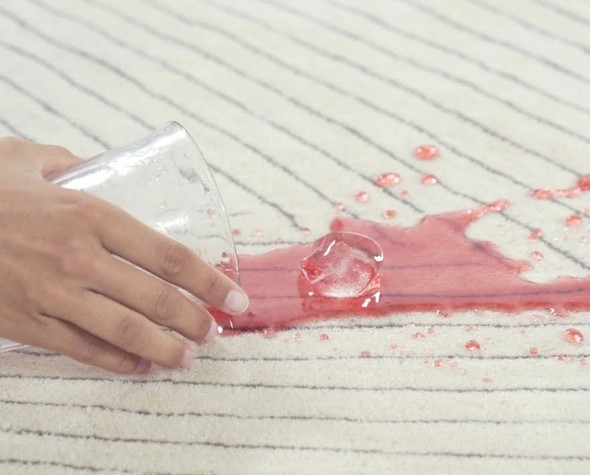
nanimarquina, the Barcelona design house, manufactures a large part of its collection in India. For many years its Indian production has used Vetro Power Textile Protect: the coating is applied at the factory, and nanimarquina sells the stain-resistant, water-repellent and oil-repellent finish as a feature of the rug. On its own site the brand describes the treatment as repelling water-based and oil-based stains on all types of fibre, which is exactly what the rug in the video is doing.
|
Jaipur Rugs and Jaipur Living: from factory finish to a service in every showroom
Jaipur Rugs, one of the world's largest hand-knotted rug makers, offers Vetro Power stain protection as a paid add-on on every product and as a stand-alone service across India. Vetro Power supplied more than the product. We trained their factories on ordering and application, trained their shops so each one works as a service centre, and set up the home-visit teams that treat rugs already in customers' homes. The same programme runs across the company's overseas business, including Jaipur Living in the United States, where the coating is offered as a factory-applied add-on with a warranty.
|
If you make, sell or clean rugs, this is the programme we set up with you: product, training, application method and a service you can sell. See how the service programme works.
Also applied for Cocoon Fine Rugs, Venjara Carpets, Maurya International, Carpet Couture by Rashi, Extra Weave and Rafa Rugs.
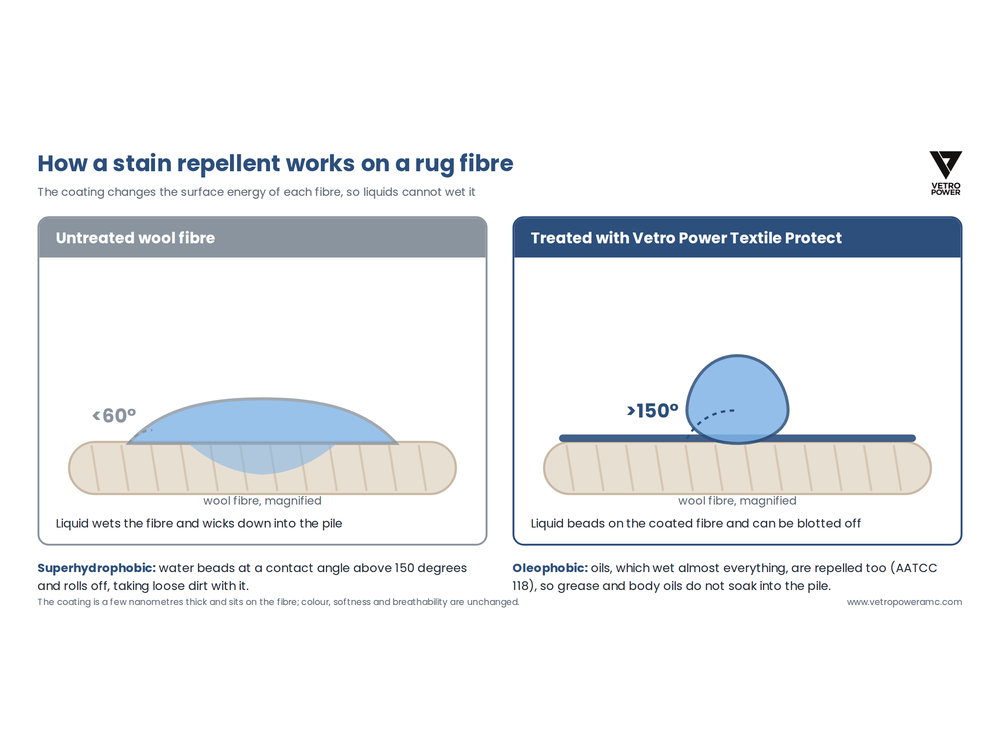
How Vetro Power Textile Protect works on a single rug fibre. Left, an untreated fibre soaks up the drop. Right, the treated fibre makes it bead so it can be blotted off.
What changes on a treated rug
| Spill or soil | Untreated rug | Treated with Textile Protect |
|---|---|---|
| Tea, coffee, wine, juice | Wicks into the pile in seconds; dye bonds to the fibre | Beads on the surface; blot it off with a cloth |
| Pet accidents | Soaks through to the backing; odour stays | Held on the surface long enough to clean up |
| Food grease, cosmetics | Absorbed; needs a shampoo | Repelled rather than absorbed; a wipe, not a shampoo |
| Tracked-in dry soil | Clings to the fibre; greys the traffic lane | Releases on normal vacuuming |
| Look and feel | As made | Unchanged: same colour, sheen, softness and breathability |
Who we work with
Rug manufacturers and exporters Who want to sell a stain-resistant finish on hand-knotted, tufted and flatweave rugs without PFAS chemistry. |
Hotels, restaurants, offices and retail Where carpet is cleaned often and replaced early because of staining. |
Professional carpet cleaners Who apply protector after every clean and want a PFOA-free and PFAS-free product to offer. |
Interior designers Specifying natural-fibre rugs in wool, jute, sisal and silk for homes and hospitality. |
Offer stain protection as a service: how the programme works
This is the programme Jaipur Rugs runs today, and it is the same three steps for any rug maker, retailer or cleaning company.
1 We supply
|
2 You apply
|
3 You sell it
|
Send us your rug construction and monthly volume and we will set up a stain-resistant rug programme with you. Enquire now.
Fibres and constructions
- Wool, cotton, silk, jute, sisal, viscose, polyester, nylon, polypropylene and blends.
- Hand-knotted, hand-tufted, flatweave, broadloom, carpet tiles, and rugs with cotton or latex backing.
- Test on an offcut first. A small number of dyed viscose and silk rugs need a lower application rate.
How it is applied
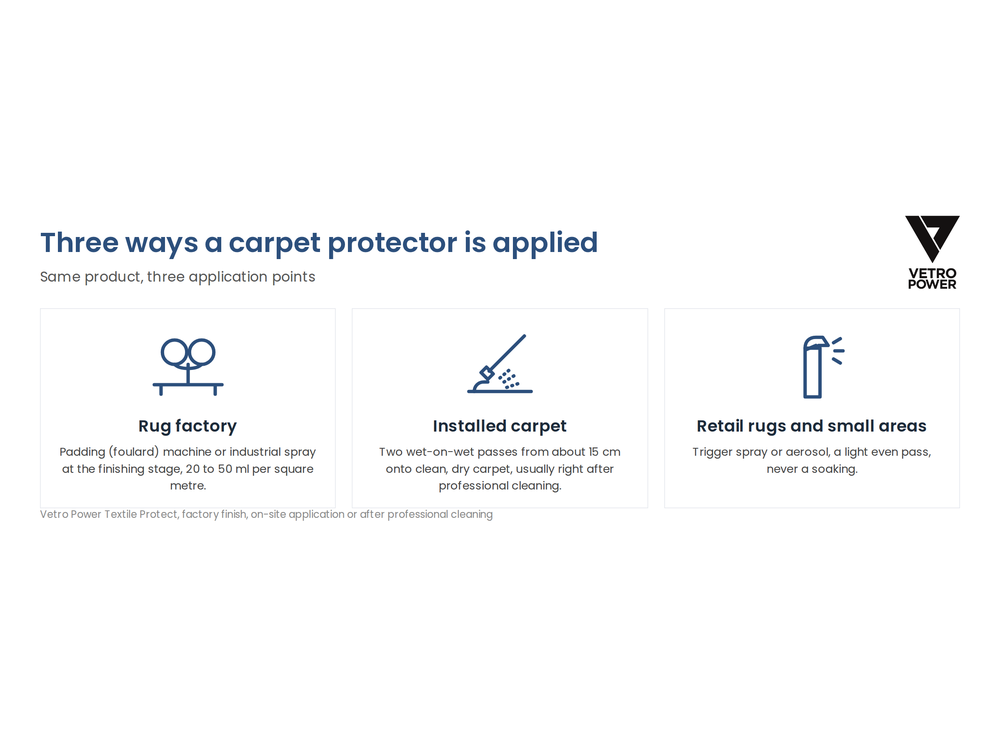
Same product, three application points: rug factory, installed carpet, retail rugs and small areas.
- Factory: padding (foulard) machine or industrial spray on the finishing line, 20 to 50 ml per square metre depending on the absorbency of the pile.
- Installed carpet: spray on clean, dry carpet in at least two wet-on-wet passes from about 15 cm, without ponding, usually after professional cleaning. Allow to dry fully before use.
- Retail and small rugs: wet-wipe and aerosol formats available.
- Reapply after deep cleaning, or every 12 to 24 months in heavy traffic.
The terms, in plain words
- Hydrophobic means water-repelling. A drop of water on a hydrophobic surface stands up as a bead instead of spreading; the angle between the drop and the surface (the contact angle) is over 90 degrees.
- Superhydrophobic is the extreme version: the contact angle is over 150 degrees, so drops roll off almost freely and carry loose dirt with them. Vetro Power Textile Protect is a superhydrophobic finish on textiles.
- Oleophobic means oil-repelling. Oils have a lower surface tension than water, so they wet almost everything; a finish that repels oil (measured by AATCC 118) is what stops food grease, cosmetics and body oils from soaking into the pile.
- PFOA-free and PFAS-free means the finish contains none of the per- and polyfluoroalkyl substances used in conventional stain protectors. PFAS are persistent in the environment and are now restricted in the EU and in several US states; PFOA is the best-known member of the group and has been banned for years.
- Breathable means the coating sits on the individual fibres and leaves the spaces between them open, so air and moisture vapour pass through and the rug stays soft.
Tested, not just claimed
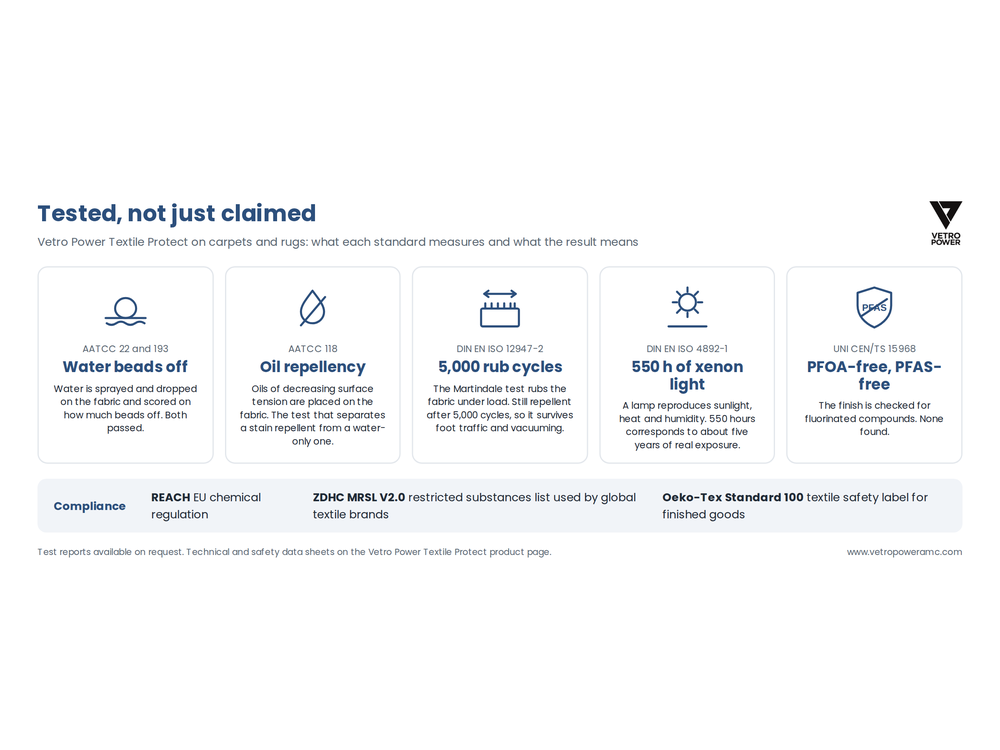
The five test standards behind the carpet and rug claims, with what each one means in plain words. REACH, ZDHC MRSL V2.0 and Oeko-Tex Standard 100 compliance is listed underneath.
- Water repellency (hydrophobic): AATCC 193 places drops of water and alcohol mixtures on the fabric and grades how long they sit without wetting; AATCC 22 (the same as DIN EN 24920) sprays water onto the fabric and scores how much beads off. Both are passed.
- Oil repellency (oleophobic): AATCC 118 places oils of decreasing surface tension on the fabric and grades the highest one that does not soak in. This is the test that separates a real stain repellent from a water-only one.
- PFOA-free and PFAS-free: verified to UNI CEN/TS 15968, the test method that checks a textile finish for fluorinated compounds.
- Abrasion: DIN EN ISO 12947-2 (the Martindale test) rubs the treated fabric under load; the coating still repels after 5,000 cycles, which is why it survives foot traffic and vacuuming rather than washing off in weeks.
- Weathering (artificial ageing): DIN EN ISO 4892-1 exposes the treated fabric to a xenon lamp that reproduces sunlight, heat and humidity. 550 hours in the chamber corresponds to about five years of real exposure, so the protection does not fade with light or age.
- Compliance: REACH (EU chemical regulation), ZDHC MRSL V2.0 (the restricted substances list used by global fashion and textile brands) and Oeko-Tex Standard 100 (the textile safety label for finished goods).
- Brochure, technical data sheet and safety data sheet on the Vetro Power Textile Protect page.
Why PFOA-free and PFAS-free matters now
Most carpet protectors are fluorochemical (C6, or older C8) and fall under PFAS restrictions in the EU and several US states. Vetro Power Textile Protect is PFOA-free and PFAS-free, so there is no PFAS restriction risk for exporters and no disclosure issue for hotel groups with sustainability reporting. Read more: do carpet protectors work, and what the tests show.
Frequently asked questions
Does it change the look or feel of the rug?
No. The coating is a few nanometres thick and sits on the fibre; colour, sheen and hand are unchanged. Always test on an offcut.
How long does it last on carpet?
It wears by abrasion, so it depends on traffic and cleaning. In hotel corridors and offices, reapply after each deep clean or every 12 to 24 months; in a home living room, longer.
Is it safe for wool and silk rugs?
Yes. It is used on wool, silk, jute and viscose. Silk and some viscose rugs take a lighter application rate; test first.
Is it PFOA-free and PFAS-free?
Yes. 100 percent PFOA-free and PFAS-free, verified to UNI CEN/TS 15968, and REACH, ZDHC MRSL and Oeko-Tex Standard 100 compliant.
Can a professional cleaner apply it?
Yes. It is sprayed on clean, dry carpet, the same way conventional protectors are applied after cleaning.
Do you supply rug manufacturers in bulk?
Yes. Bulk packs for finishing lines, application guidance per construction, and private label are available.
 Back
Back