
19 Sep 2026
Do carpet protectors work? What the tests show, and why PFOA-free and PFAS-free matters now
How carpet and rug protectors work, what Scotchgard and Teflon actually are, how long a protector lasts, and what changes when you switch to a PFOA-free and PFAS-free nano coating.
If you have ever paid a carpet cleaner extra for "protector" and wondered whether anything was actually applied, you are not alone. It is the most common question on professional cleaners' forums. So here is the honest version: how carpet protectors work, what they are made of, how long they last, and what has changed in the last few years that makes the old answer out of date.
The short answer
- Do carpet protectors work? Yes, if the protector is applied at the right rate on clean carpet and reapplied after deep cleaning. A tested coating lasts about five years; wear and cleaning shorten that.
- Almost every protector sold in the last forty years is a fluorochemical, which is now a PFAS compliance question for exporters and hotels.
- PFOA-free and PFAS-free nano coatings match them on water-based spills; on pure oil they score lower on the lab test, and in real use the difference is small.
How a carpet protector works
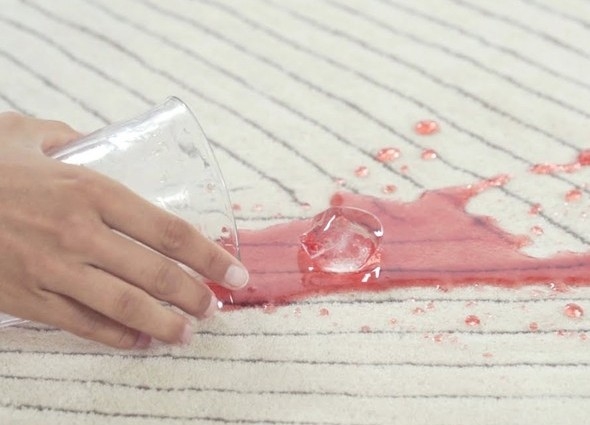
Carpet fibre, whether wool, nylon or polypropylene, has a surface that liquids can wet. When a spill lands, it spreads along the fibre, wicks down into the pile and, if it carries dye or oil, bonds there. A protector changes the surface energy of the fibre so that liquids cannot wet it. Instead of spreading, a spill beads and sits on top of the pile, where it can be blotted off.
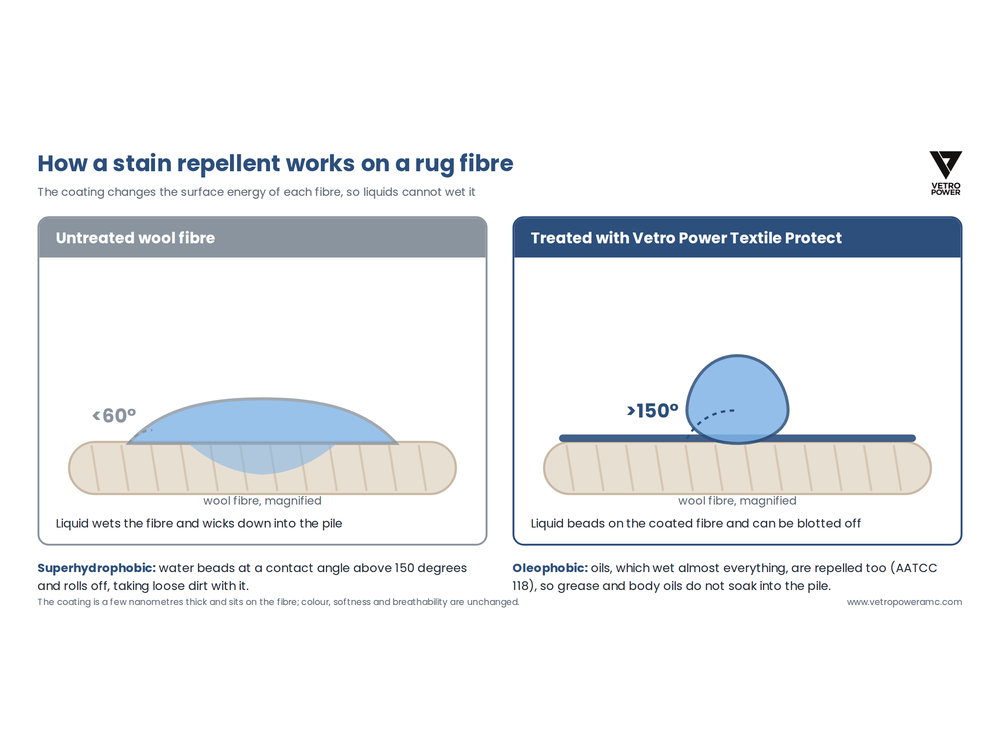
Left, an untreated fibre soaks up the drop. Right, a treated fibre makes it bead so it can be blotted off.
The protector does not make the carpet waterproof; it buys time. A spill blotted in the first minute leaves nothing; the same spill left overnight will still stain a protected carpet, just less.
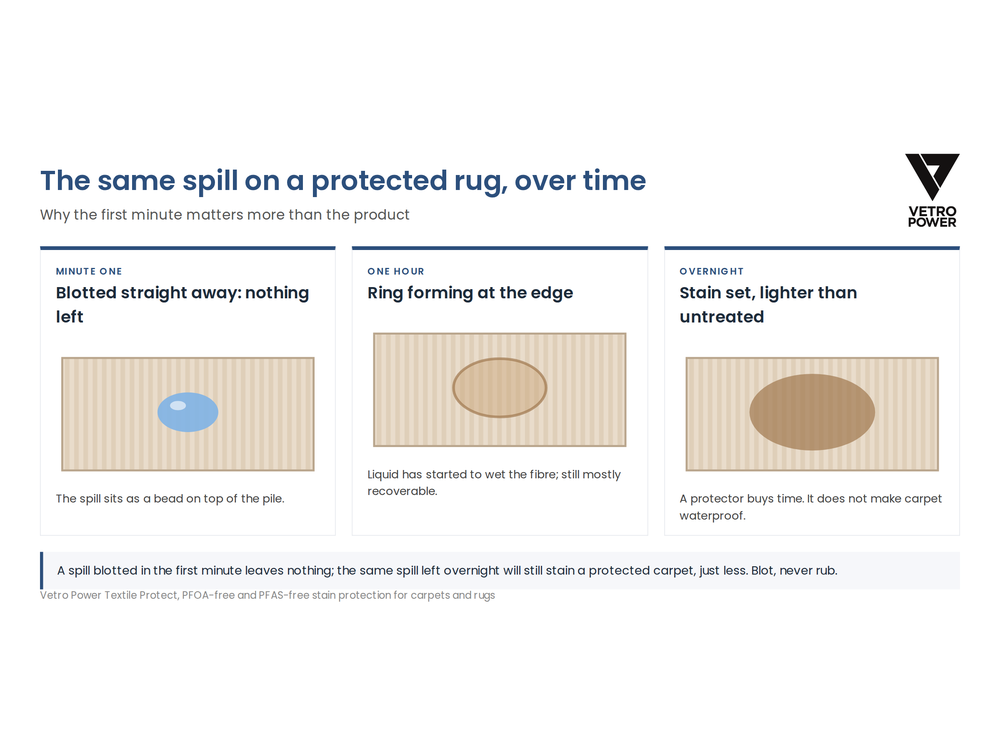
The same spill on a protected rug over time. A protector buys time; the first minute matters more than the product.
The second effect is on dry soil. Grit and dust cling less to a low-energy surface, so more of it lifts on normal vacuuming. This is why protected carpet in offices looks cleaner between deep cleans even though it has had the same foot traffic.
What Scotchgard, Teflon and the others actually are
Almost every carpet protector sold in the last forty years is a fluorochemical: a fluorinated polymer that gives both water and oil repellency. Scotchgard is 3M's, Teflon Advanced was DuPont's, and most professional-grade protectors are private-label versions of the same C6 chemistry (earlier products were C8, which was phased out because of its persistence). They work well. They are also all in the family of substances now called PFAS, and that is where the story has moved.
PFAS restrictions have arrived in stages: consumer product bans in several US states, the EU's proposed universal PFAS restriction under REACH, and retailer and hotel-group policies that go further than the law. For a rug exporter or a hotel procurement team, a fluorochemical protector is now a compliance question, not just a performance one.
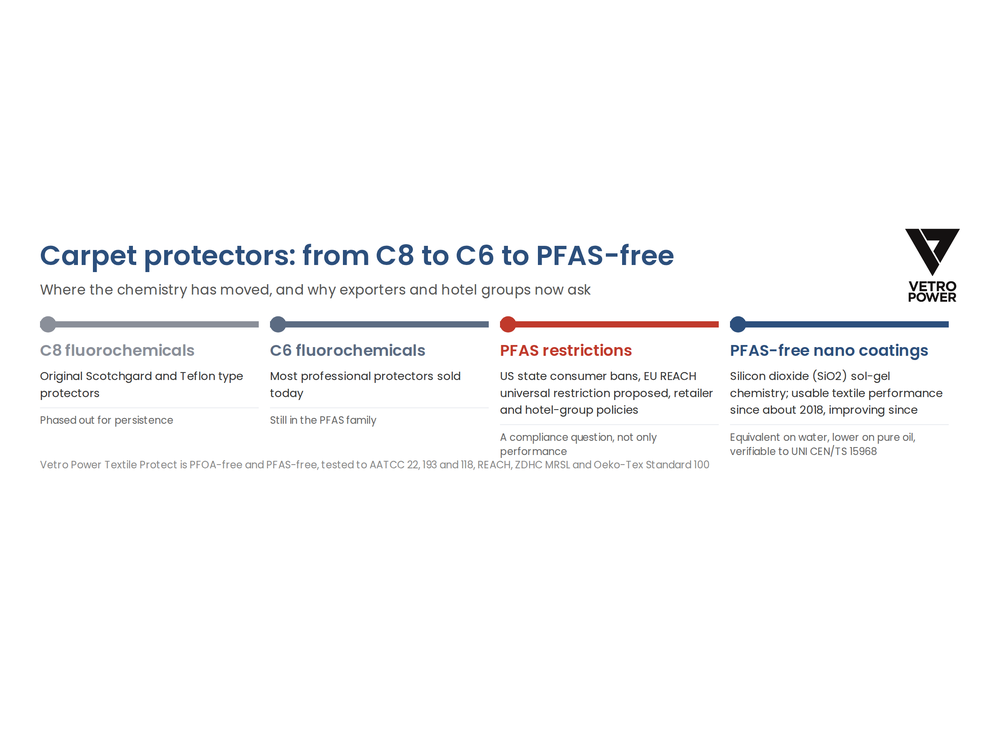
Where carpet protector chemistry has moved: C8, C6, PFAS restrictions, PFAS-free.
PFOA-free and PFAS-free protectors: what changes
PFAS-free protectors reached usable performance on textiles around 2018 and have improved since. Vetro Power Textile Protect uses silicon dioxide (SiO2) sol-gel chemistry: a water-based liquid that forms a glass-like layer around each fibre, with no fluorine in it at all. On water-based spills the performance is equivalent to a fluorochemical; this is the AATCC 22 spray test and the AATCC 193 water drop test, and a good PFAS-free product passes both. On oil the picture is more honest: fluorochemicals are unbeatable on pure oil repellency (AATCC 118), and PFAS-free products score lower on that specific test, although on real-world soiling (food grease, cosmetics, tracked-in dirt on carpet) the difference is small because most of that soil is mixed, not pure oil.
| Fluorochemical protector (Scotchgard, Teflon type) | PFOA-free and PFAS-free nano coating | |
|---|---|---|
| Chemistry | C6 fluorinated polymer (older products C8) | Silicon dioxide (SiO2) sol-gel, water-based |
| Water-based spills (AATCC 22 and 193) | Pass | Pass, equivalent |
| Pure oil (AATCC 118) | Highest scores | Lower on the lab test; small difference on mixed real-world soil |
| PFAS status | In the PFAS family | PFOA-free and PFAS-free, verifiable to UNI CEN/TS 15968 |
| Regulation | US state bans, proposed EU REACH restriction, retailer and hotel policies | Not affected |
| Wear | Removed by abrasion and cleaning | Removed by abrasion and cleaning |
Vetro Power Textile Protect, the product we make, is a PFOA-free and PFAS-free nano coating tested to AATCC 22, 193 and 118, verified PFAS-free to UNI CEN/TS 15968, and compliant with REACH, ZDHC MRSL and Oeko-Tex Standard 100. We publish those numbers because the question "what is being applied to my carpet" deserves a document, not a brand name.
How long does a carpet protector last?
The coating itself is built to last about five years. Vetro Power Textile Protect keeps its repellency through 5,000 Martindale rub cycles (DIN EN ISO 12947-2) and 550 hours of xenon-lamp weathering (DIN EN ISO 4892-1), which is roughly five years of sunlight. What shortens that in practice is not time but abrasion and cleaning. Foot traffic and cleaning wear it off the tips of the pile first, which is why the traffic lane in a corridor loses protection before the edges. As a rule: reapply after every hot-water extraction clean, because the cleaning itself removes some protector; in heavy commercial traffic plan on 12 to 24 months; in a home living room, two years or more. The test that predicts this is abrasion resistance (DIN EN ISO 12947, the Martindale test); ask for the cycle count.
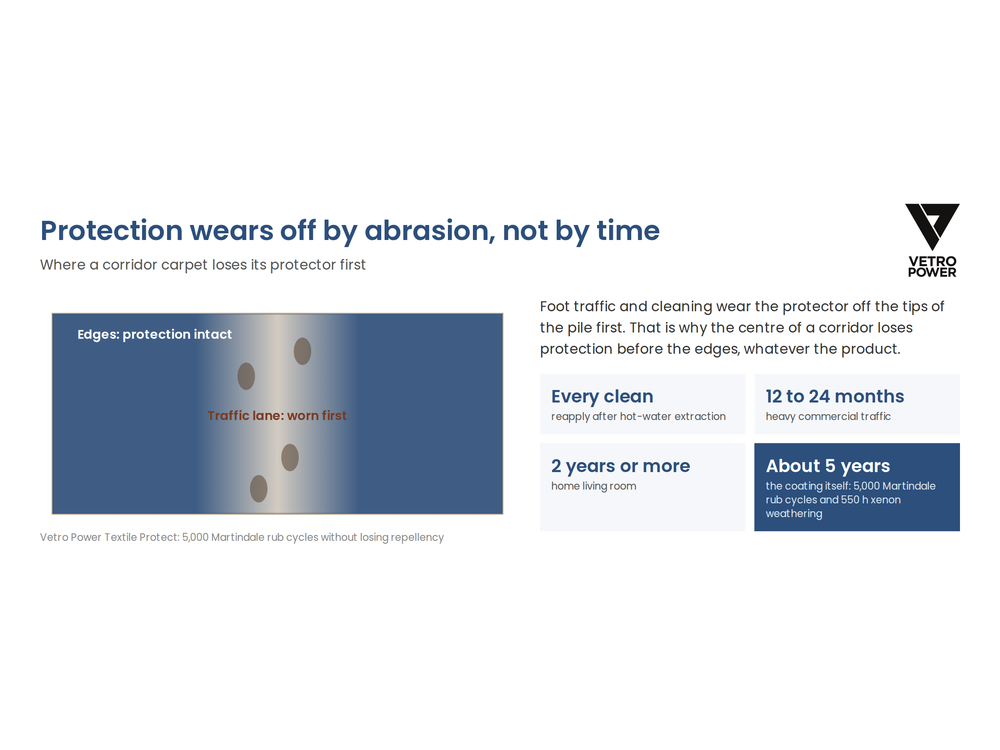
Where a corridor carpet loses its protector first, what the coating itself is tested to, and the reapplication rule.
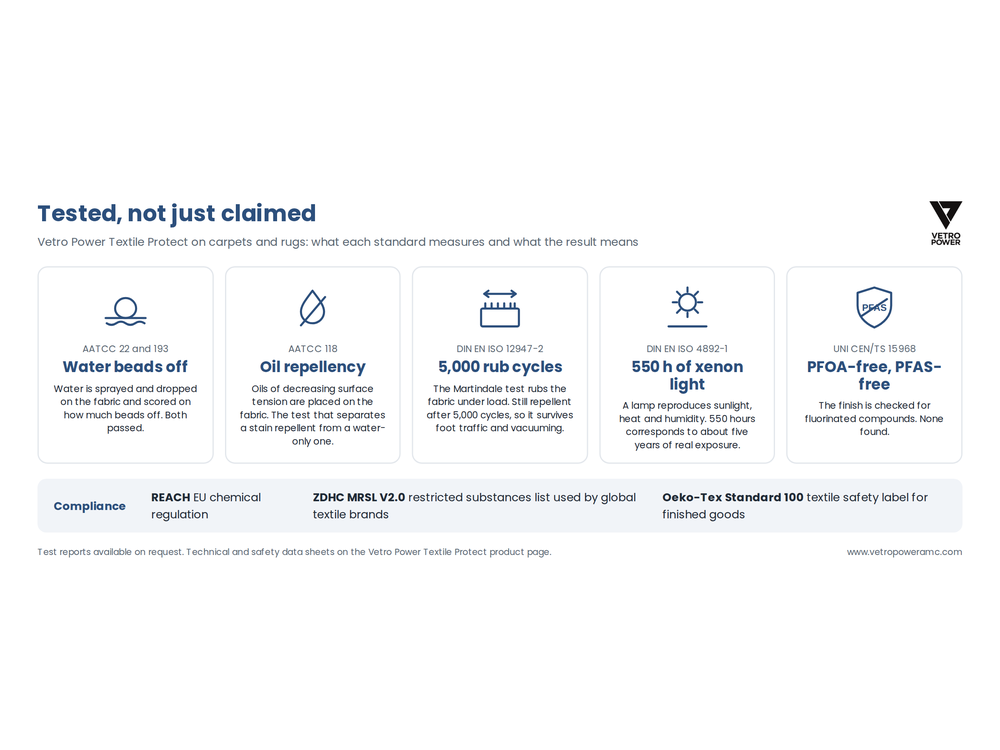
The five tests to ask any protector supplier for, and what each one means in plain words.
Applying it: factory, on site, or after cleaning
Rug factory At the finishing stage, through a padding (foulard) machine or by industrial spray, at 20 to 50 ml per square metre depending on how absorbent the pile is. The cheapest point to apply it and the only way to sell a rug as "stain-resistant" honestly. |
Installed carpet Sprayed onto clean, dry carpet in at least two wet-on-wet passes from about 15 cm, usually right after professional cleaning, and left to dry fully before the room is used. |
Retail rugs and small areas A trigger spray or aerosol works; the technique is a light, even pass, not a soaking. The same rule applies to any carpet stain protector or rug protector spray bought for a home with pets or children: clean first, then a light coat. |
Jaipur Rugs showing how its stain-resistant rugs behave with a spill.
Which fibres
Wool, silk, jute, sisal, viscose, cotton, nylon, polyester and polypropylene all take a protector. Natural fibres benefit most because they absorb most. Silk and some dyed viscose rugs need a lighter application rate and a test on an offcut, which is true of every protector on the market.
WoolSilkJuteSisalViscoseCottonNylonPolyesterPolypropylene
So, do they work?
Yes, with three conditions.
| 1 | The product has to be applied at the right rate on clean carpet; a protector sprayed over soil protects the soil. |
| 2 | It has to be reapplied after deep cleaning. |
| 3 | You should know what it is: ask for the technical data sheet and the test standards, and if the answer is a brand name and nothing else, ask again. If PFAS matters to your business, and for exporters and hotel groups it now does, ask specifically whether the product is PFOA-free and PFAS-free and how that was verified. |
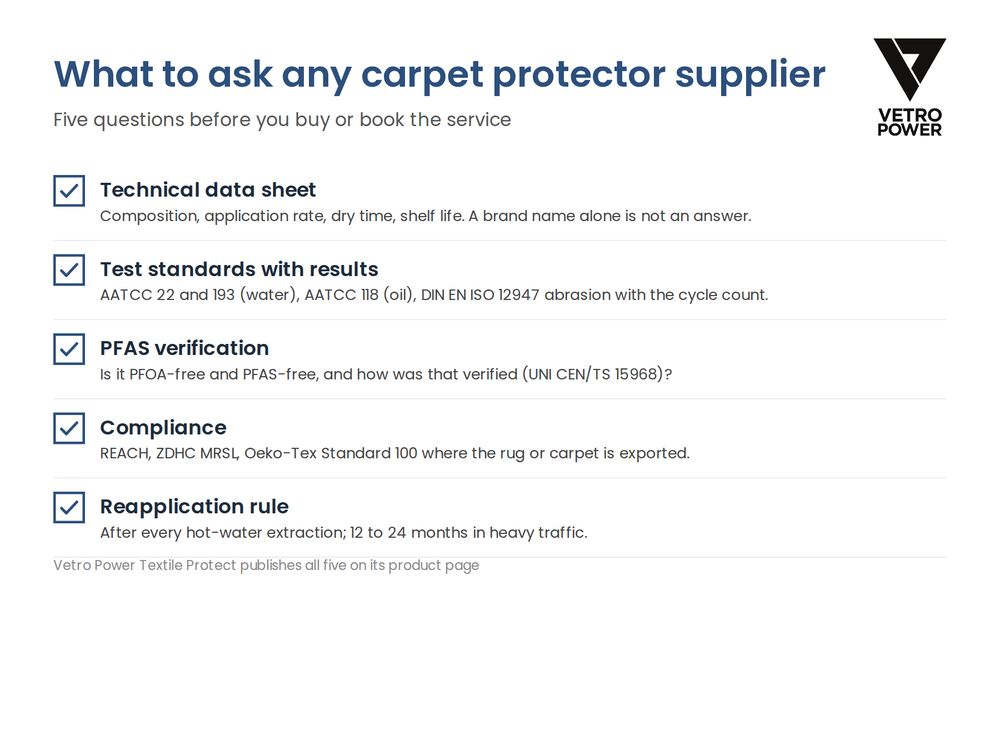
Five questions to ask any carpet protector supplier before you buy or book the service.
Vetro Power Textile Protect is a PFOA-free and PFAS-free stain and water repellent nano coating for carpets, rugs and upholstery, available as a factory finish or as a carpet protector spray, supplied to rug manufacturers, hotels and professional cleaners. See the carpet and rug protection page for test data and the partner programme, the product page for the technical and safety data sheets, and how fabric protector works for upholstery.
Related Products
Vetro Power Textile Protect
Vetro Power Textile Protect is a PFOA-free and PFAS-free fabric protector: a water-based SiO2 nano coating that makes upholstery, carpets, rugs and textiles superhydrophobic and oleophobic.
Learn More