

Non-Stick Coating for Stainless Steel Food Equipment: How ITC Bingo Stopped Seasoning Build-Up
- Chemistry: polysilazane, fluorine-free, solvent-based, ready-to-use
- Food contact: complies with EC 1935/2004 once cured
- Temperature: -50 °C to over 300 °C
- Cleaning: pH 3 to 12 cleaners; neutral cleaners generally sufficient
- Coverage: roughly 800 to 1,000 ft² per litre (industrial, practical)
- Service life: up to 5 years; reapply every 4 to 5 years
- Cure: dry to touch in about 1 hour; fully effective after 5 to 7 days
The problem: seasoning sticking to bare stainless steel
On a snack line the seasoning is the product, and it is also the maintenance problem. At ITC's Bingo plant the multihead weigher that portions chips into packs is built from bare stainless steel. Every bucket, chute and hopper lip that chips slide over picks up seasoning, and it builds up as the line runs.
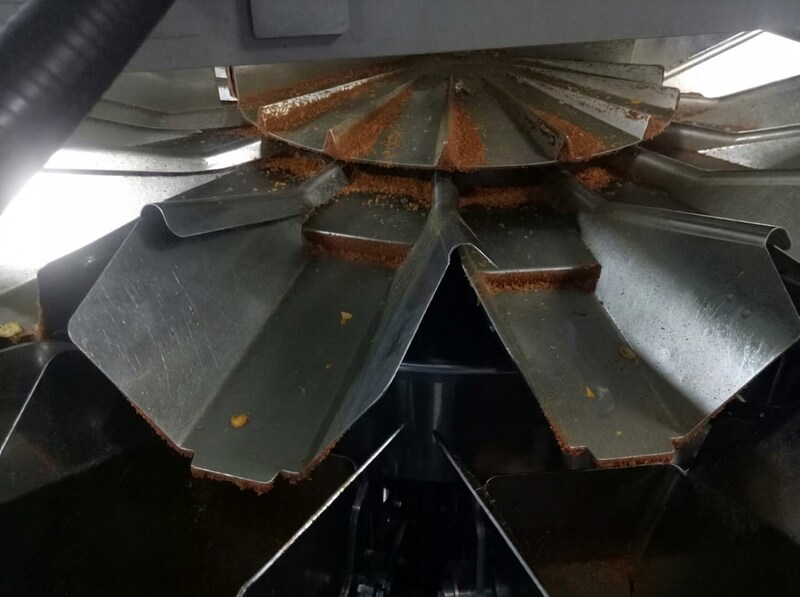
The before photograph shows it clearly. The bare buckets carry a thick, caked layer of seasoning along the lip of the hopper and in the corners of every bucket, and loose chips stick to it. The ring marks the point where the build-up is heaviest, where product drops from the top cone into the bucket. Caked seasoning like this has to be cleaned off by hand.
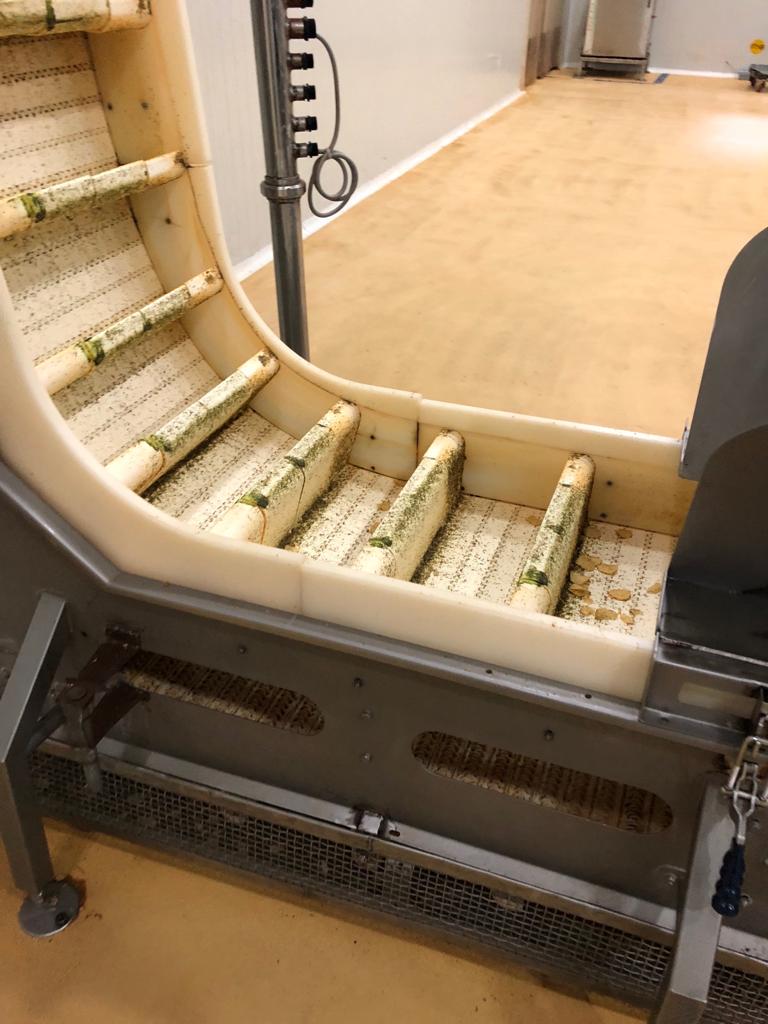
The same happens elsewhere on the line. On an inclined conveyor at the same plant, the cleats carry a green and white residue of herb seasoning.
The result: a coated bucket on a running line
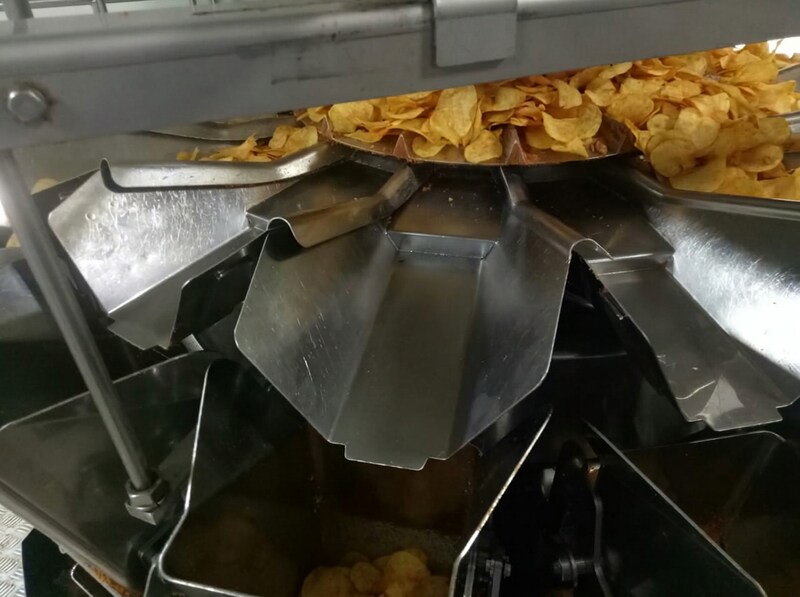
The after photograph is the same type of weigher bucket after coating with Vetro Power Nano-Dynamis. The ring marks the same hopper lip that was caked in the before photograph. It is bare, bright metal. Chips are flowing through the weigher above it, so this is a running line, not a freshly washed one. There is no seasoning film in the bucket corners and no loose chips stuck to the walls.
The coating is transparent, so the coated bucket looks like bare stainless steel. The difference is that the seasoning does not bond to it. The project record also files Vetro Power Nano-Dynamis under Teflon, food industry (ITC), alongside the weigher photographs.
| PTFE (Teflon) | Vetro Power Nano-Dynamis | |
|---|---|---|
| Chemistry | Fluoropolymer (contains fluorine) | Polysilazane, fluorine-free |
| How it is applied | Baked on as a layer | Thin liquid coat, sprayed, cures at room temperature |
| Appearance | Transparent, stainless steel keeps its own look | |
| Bond to metal | Bonds chemically to the substrate |
What a non-stick coating for stainless steel does on the metal
Vetro Power Nano-Dynamis is a clear, ready-to-use coating based on polysilazane technology. It forms a barrier layer that bonds chemically with the substrate and cures at room temperature with atmospheric humidity. Once cured the surface is superhydrophobic and oleophobic, so water and oil do not wet it, and the protected surface can be cleaned repeatedly without reapplying the product. The coating is neither matt nor gloss. It is invisible after application, so the stainless steel looks exactly as it did before.
Why it suits a food plant
Food contact. Once the product has cured it complies with the requirements under the European Framework Regulation (EC) 1935/2004 relating to Food Contact Materials. It is also fluorine-free, so it is not a PTFE or fluoropolymer non-stick system.
Heat. The coating tolerates -50 °C to over 300 °C and is heat resistant up to 300 °C.
Cleaning. Coated surfaces are cleaned with cleaners in the pH 3 to 12 range. Strong mineral acids and alkalis should be avoided and are unnecessary, because neutral cleaners are generally sufficient to clean coated surfaces.
Durability. The coating is UV resistant and, once fully cured over 5 to 7 days, forms a very strong bond with the substrate. It does not discolour, crack or peel. Chemical cleaners or acid will not remove it. Reapplication is recommended every 4 to 5 years.
Specifications
| Base | Polysilazane, solvent-based, ready-to-use |
|---|---|
| Substrates | Stainless steel, aluminium, zinc, copper, brass, bronze and other smooth, non-absorbent surfaces |
| Food contact | Complies with EC 1935/2004 once cured |
| Temperature range | -50 °C to over 300 °C |
| Corrosion test | Salt spray in accordance with ASTM B117 |
| Density | approx. 0.92 g/cm³ |
| Flash point | below 21 °C |
| Coverage | roughly 800 to 1,000 ft² per litre (industrial, practical) |
| Service life | up to 5 years; reapply every 4 to 5 years |
| Shelf life | 12 months from delivery date, at 20 °C |
| Packaging | 1 L, 5 L, 20 L, 200 L |
How the non-stick coating is sprayed and cured on food equipment
Where else it applies
The ITC Bingo weigher is one stainless steel surface in a plant full of them. The product data lists the same coating for tank equipment and industrial plant, inside and outside, ventilating systems, industrial plant and equipment, and any metal surface exposed to water vapour. It is also suited to smooth, non-absorbent surfaces around the metal: polyurethane and epoxy paint systems, polyester paints and GRP. For fingerprint and smudge control rather than release, see the related post on anti-fingerprint coating for stainless steel, and the full metal coatings range.
If you run a food line and are cleaning seasoning or product off stainless steel by hand, the quickest way to find out whether this works for you is a test coat on one bucket or one chute.
Vetro Power Nano-Dynamis
Food-safe, non-stick polysilazane nanocoating for stainless steel and metal equipment.
View the product Request a trialFrequently asked questions
Related Products
Vetro Power Nano-Dynamis Anti-Corrosion Coating
Ready-to-use, Polysilazane Nanotechnology-based Superhydrophobic, Oleophobic, Transparent, Anti-Graffiti, Easy-to-clean & Anti-Corrosion Nanocoating for Metal & Stainless Steel Surfaces.
Learn More