
Hydrophobic Coating for Car Glass and Windshields: What It Does and How It Works
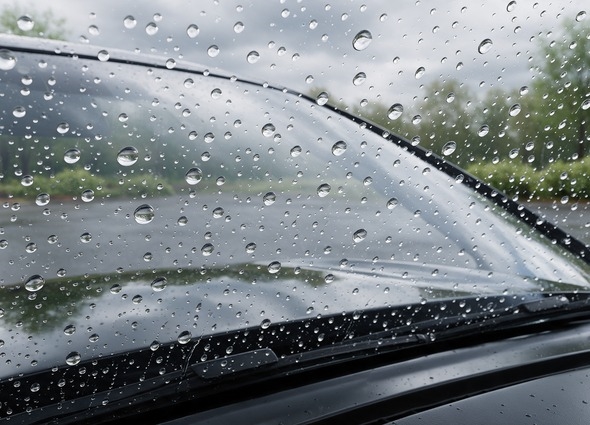
A hydrophobic coating changes how water behaves on your car glass. Instead of spreading into a sheet that the wipers smear, rain stands up as beads and rolls off, and at speed the airflow clears the windshield on its own. In heavy rain that means a clearer view with less wiper work. This post explains what a water-repellent windshield coating is, what it does on the glass, and what it does not do, using the test data behind Vetro Power’s own car glass coatings.
What a hydrophobic glass coating is
Vetro Power supplies car glass coatings as a silicon dioxide (SiO2) sol-gel. It bonds to the glass as a layer a few nanometres thick and makes the surface water-repellent. It is not a film or a tint, and it does not add thickness. The coating is PFOA-free and PFAS-free, with no fluorinated repellents. The measure of water repellency is the water contact angle, which is how high a drop of water stands on the surface.
Water contact angle measured by Polymer Service GmbH. Above about 90 degrees a surface counts as hydrophobic, and the higher the angle, the faster rain runs off. Still 95.3 degrees after 3,500 hours of UV weathering (ISO 11507).
What changes on the glass
Because there is no change in light transmission or reflection, the coating does not interfere with rain sensors or ADAS cameras, which read through the outside of the glass as before. Tint film sits on the inside of the glass and is not touched.
What a glass coating does not do
Two grades, pick by how long it needs to last
Both are the same SiO2 chemistry at different concentrations, applied and maintained correctly. In artificial UV weathering to ISO 11507 for 3,500 hours, which is roughly the sunlight a windshield sees over years of outdoor parking, the professional grade fell only from 116.7 to 95.3 degrees, so the glass was still strongly water-repellent at the end of the test. Re-apply when water stops beading.
Tested performance
The figures below are the independent certificates issued for the professional grade, Vetro Power CERAMIQ GLASS+.
How it is applied
Coverage about 11 to 14 ml per square metre; a 100 ml bottle treats the windshield of about five cars. The coating is ethanol-based with a flash point below 15 degrees C, so it is a flammable liquid: ventilate while applying and keep it away from heat.
Which Vetro Power coating to use for car glass
Questions drivers and detailers ask
Does a hydrophobic windshield coating actually work?
Yes, within what it is for. On glass coated with Vetro Power CERAMIQ GLASS+, independent testing recorded a water contact angle of 116.7 degrees against 10 to 15 degrees on untreated glass, so water beads and runs off instead of spreading. It changes how water and dirt behave on the glass. It does not stop stone chips or replace wiper blades.
How long does a windshield coating last?
Vetro Power CERAMIQ GLASS ECO is stated at up to 6 months and Vetro Power CERAMIQ GLASS+ at up to 1 to 2 years, when applied and maintained correctly. Re-apply when water stops beading.
Is it safe for rain sensors and ADAS cameras?
Yes. The coating showed no change in light transmission or reflection in FT-IR and UV-Vis testing, and it is applied to the outside of the glass, so sensors and cameras read through it as before.
Will it damage or weaken the glass?
No. Coated safety glass tested to DIN EN 12150-1 kept its flexural strength, and the coating is a silicon dioxide layer a few nanometres thick.
Related Products
Vetro Power CERAMIQ GLASS ECO Nano Coating
Eco focused ceramic glass coating for short term water repellency and easy glass maintenance.
Learn More
Vetro Power CERAMIQ GLASS+ Nano Coating
Professional ceramic glass coating for long lasting water repellency, improved visibility, and reduced maintenance.
Learn More