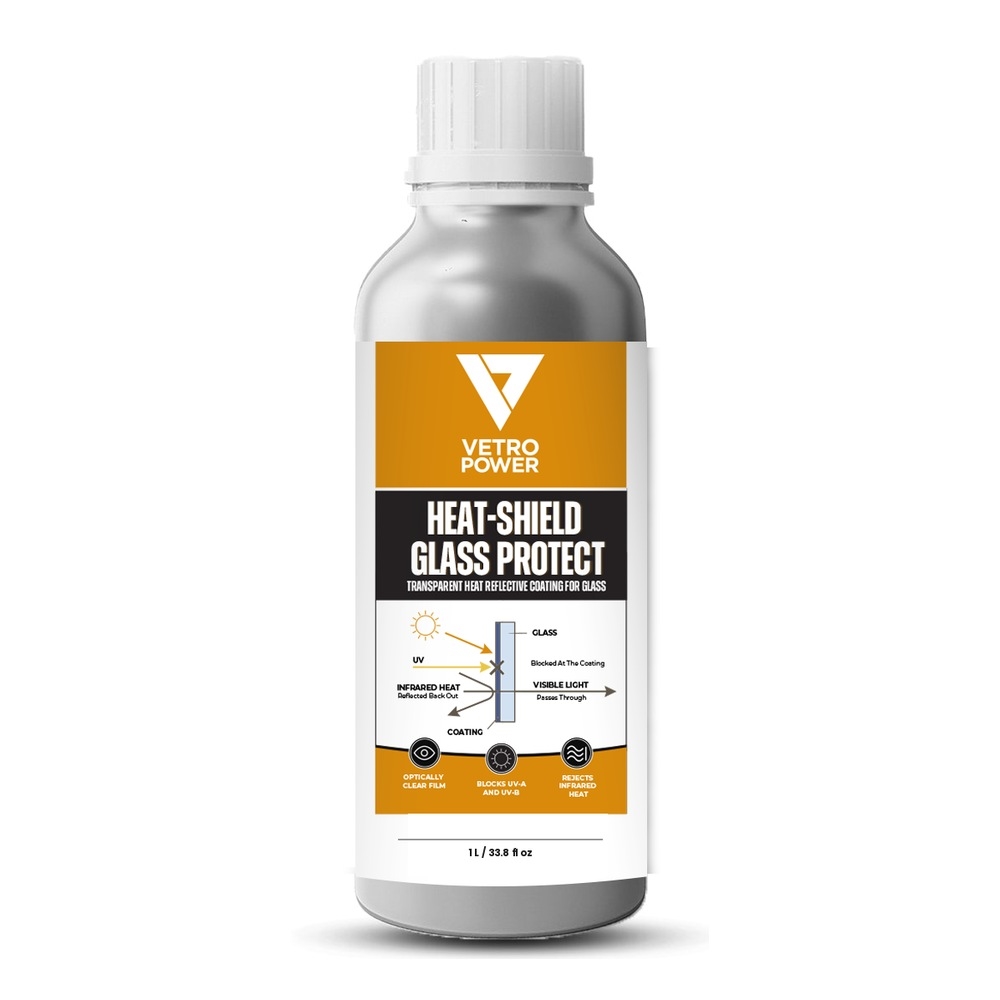
Vetro Power Heat-Shield Glass Protect
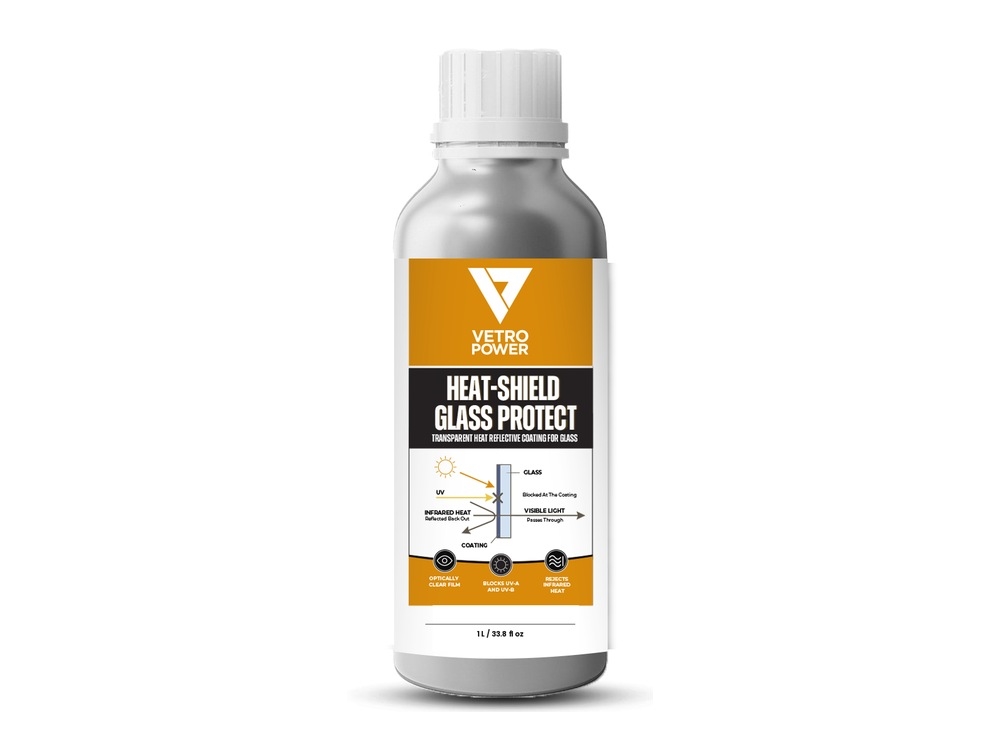
Vetro Power Heat-Shield Glass Protect
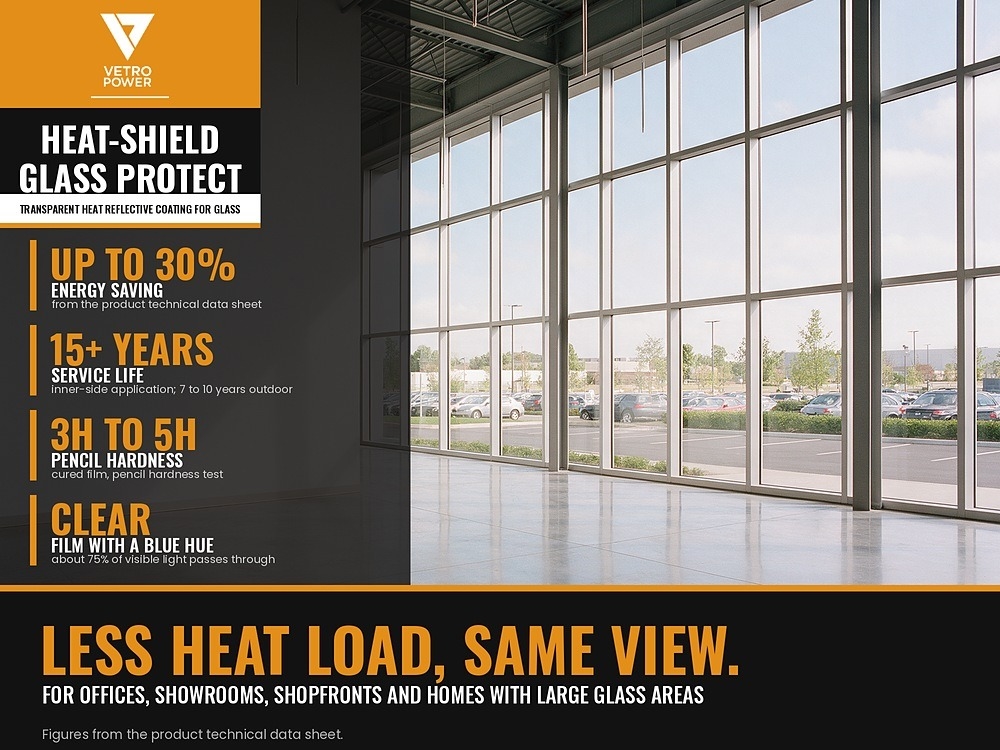
Transparent heat reflective coating for glass. One coat on existing glass blocks UV and near-infrared heat and keeps the view clear: the coating alternative to solar control window film.
Benefits
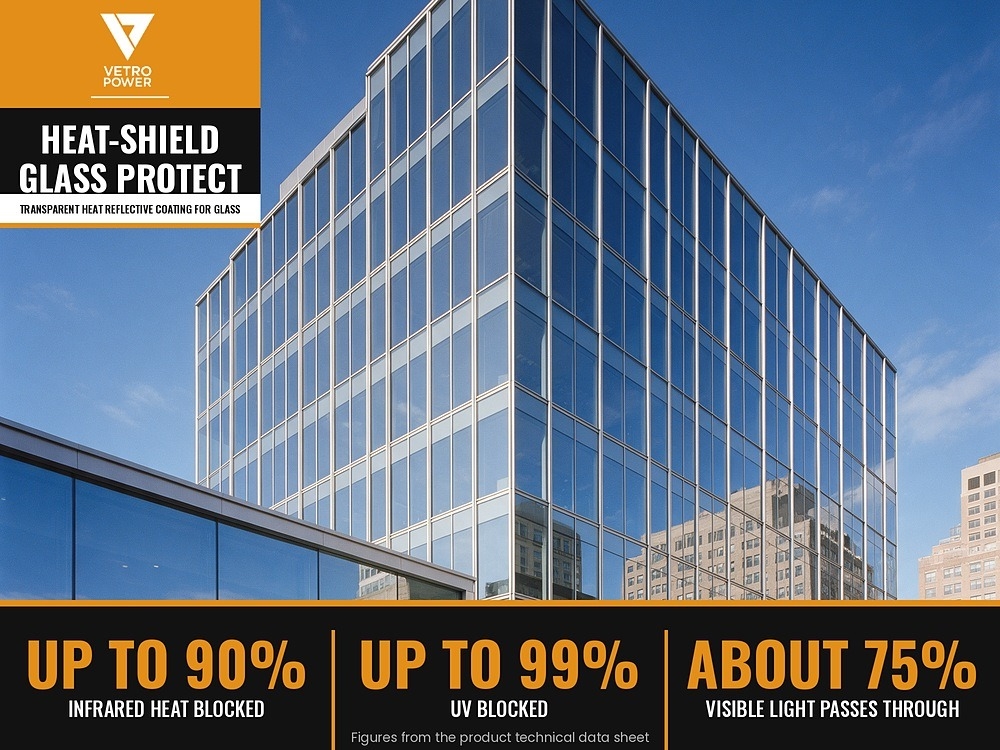
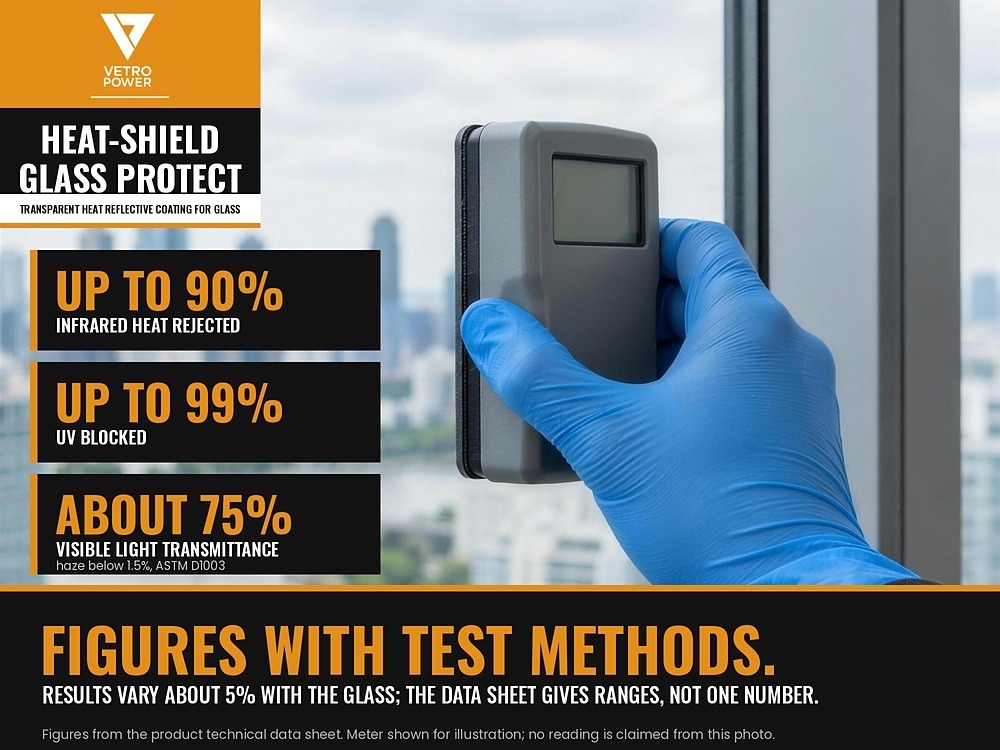
- Blocks up to 99% of UV-A and UV-B rays, protecting skin, furniture, fabrics and artwork from fading
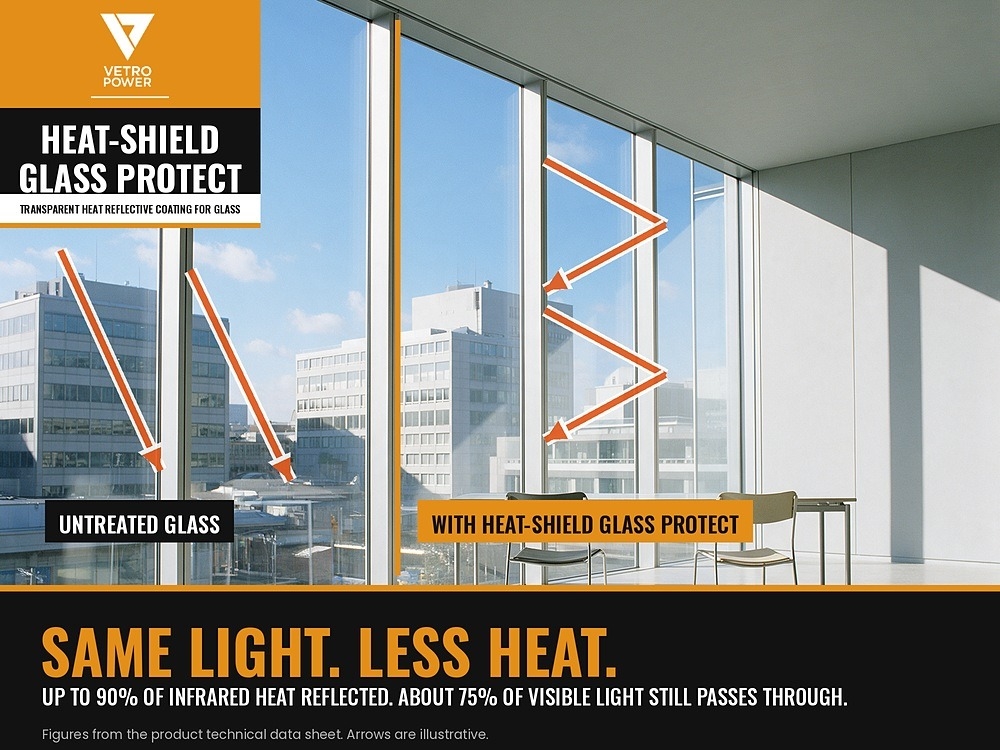
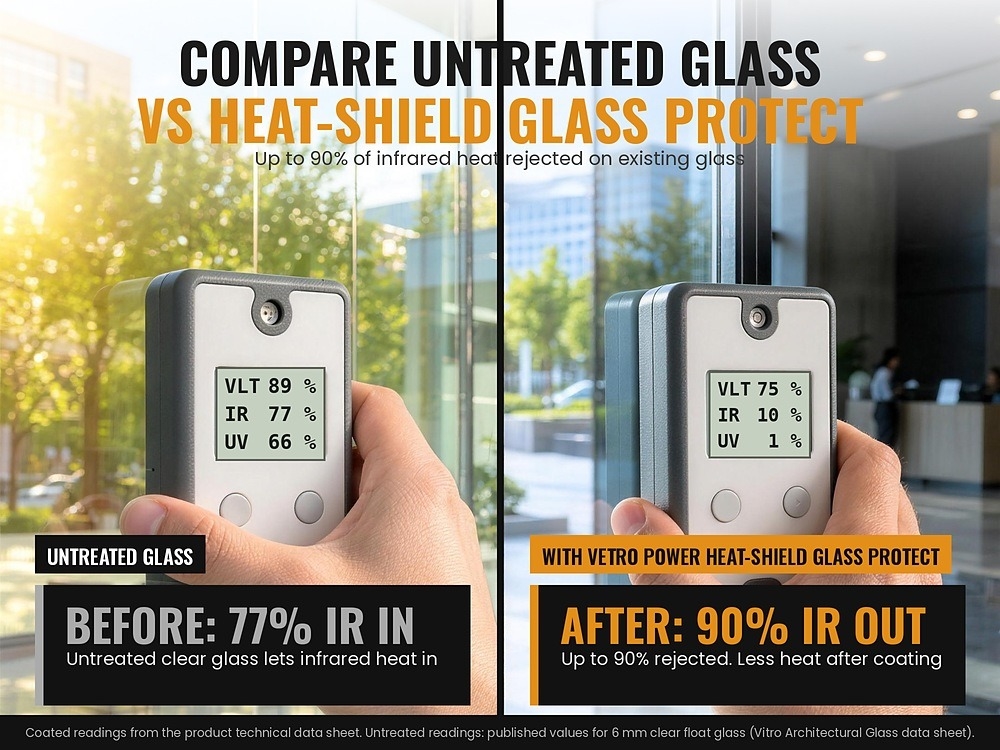
- Rejects up to 90% of near-infrared heat (780 to 2500 nm) without darkening the glass
- Optically clear film, about 75% visible light transmittance, haze below 1.5% (ASTM D1003)
- Reduces condensation on glass in air-conditioned spaces
- Lowers the cooling load on HVAC systems by up to 30%
- A coating, not a film: no sheet, no adhesive, no edges or joins
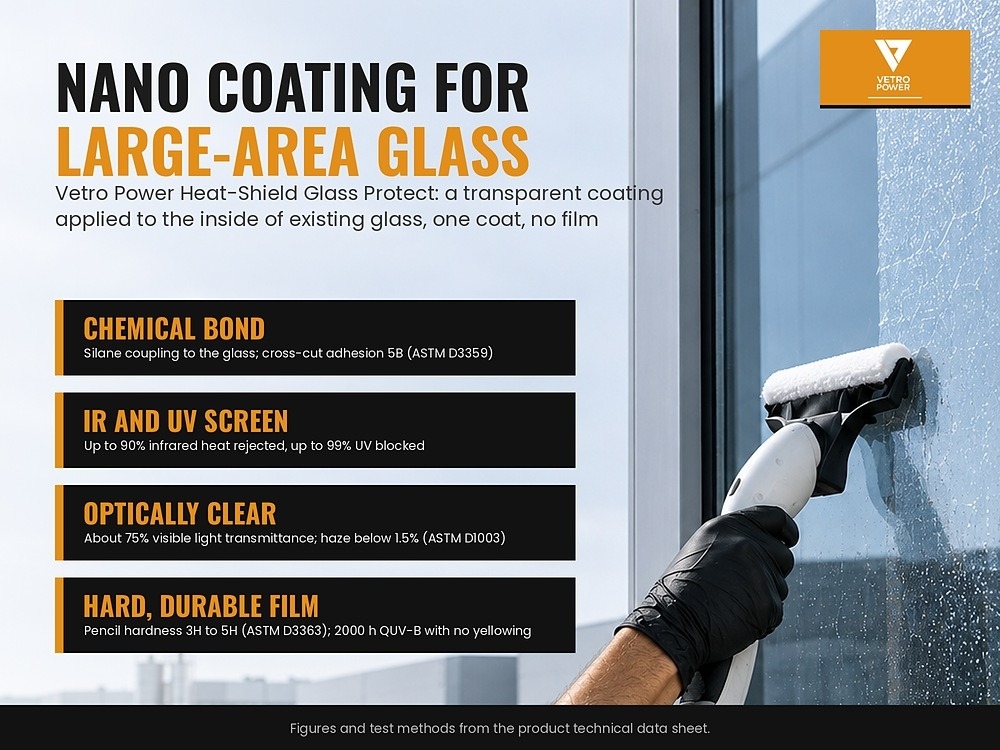
- Applied to existing glass in a single coat by spray or roller, no primer
- Pencil hardness 3H to 5H, cross-cut adhesion 5B
- Over 2000 hours QUV weathering and over 500 hours salt spray
- 10-year limited warranty on inner-side application, subject to recommended care and maintenance

Performance & Testing
- UV blocking up to 99%, IR rejection up to 90%: ASTM E903 / ISO 9050 on 5 mm clear float glass
- Visible light transmittance about 75%: ASTM E1084 / ISO 9050
- Haze after curing below 1.5% (ASTM D1003)
- Accelerated weathering (QUV-B): pass, over 2000 hours (ASTM G154)
- Salt spray: over 500 hours, no blistering (ASTM B117)
- Adhesion: 5B cross-cut, no removal (ASTM D3359)
- Abrasion: below 5% haze increase after 100 Taber cycles (ASTM D1044)
- Third-party test reports available on request
Specifications
| pH-value (undiluted) | 7.0 to 10.0 |
| Density (g/ml) | 1.00 to 1.05 |
| Flash Point (°C) | 54 °C (flammable liquid) |
| Colour | Dark blue liquid; cured film clear with a blue hue |
| Shelf Life | 12 months |
Vetro Power Heat-Shield Glass Protect is a transparent heat-reflective nano coating for glass, a liquid alternative to solar control window film. One coat on existing glass rejects up to 90% of near-infrared heat (780 to 2500 nm), blocks up to 99% of UV-A and UV-B, and keeps the view clear at about 75% visible light transmittance. It lowers the cooling load on HVAC systems by up to 30%, has a pencil hardness of 3H to 5H, a service life of 15 years and more on inner-side application, and a 10-year limited warranty.
Vetro Power Heat-Shield Glass Protect is a transparent heat reflective coating for glass. It is a liquid, applied in a single thin coat directly onto existing glass, where it cures into a clear film that blocks ultraviolet and near-infrared radiation and lets visible light through. Windows, facades, skylights and shopfronts keep their daylight and their view, with less solar heat and less fading coming through the glass.
The coating is solvent-based and is applied and cured in a ventilated space. It does the job that solar control window film and heat reflective window film are bought to do. There is no sheet to cut, no adhesive layer and no edges or joins on the glass. The film forms on the glass and bonds to it through silane-coupling chemistry, so no primer is needed.
How the coating works
Sunlight arriving at a window is made up of ultraviolet, visible light and near-infrared heat. The cured film treats the three differently.
There are no fixed single values for these three figures. Results move by about 5% either way with the glass they are applied to, which is why each is given as a range or an upper limit.
The film is a doped nano material in an acrylic-polysiloxane hybrid binder. It is 5 to 10 microns thick when dry, from a 20 to 60 micron wet coat, with a refractive index of 1.45 to 1.55, which is close to that of glass itself.
A coating instead of window film
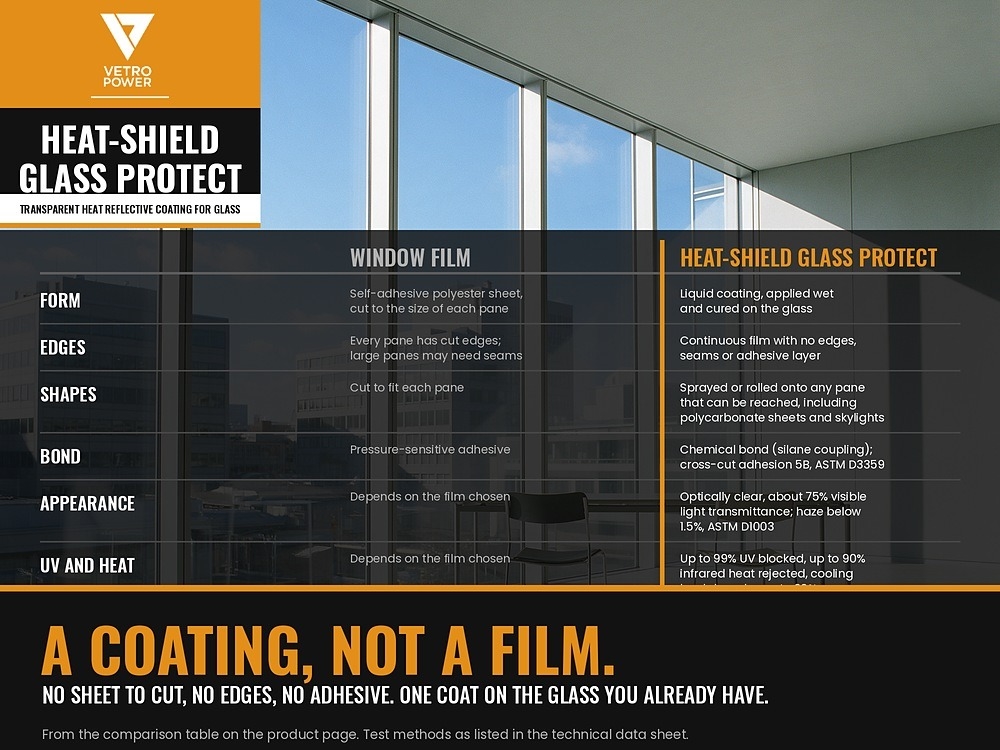
Solar control window film, heat reflective window film and sun control film are the usual ways to cut heat and UV through existing glass. Vetro Power Heat-Shield Glass Protect does the same job as a liquid. The table sets out the practical differences.
| Window film | Vetro Power Heat-Shield Glass Protect | |
|---|---|---|
| Form | Self-adhesive polyester sheet, cut to the size of each pane | Liquid coating, applied wet and cured on the glass |
| How it goes on | Sheet is laid on wetted glass and squeegeed flat | Single coat by HVLP spray, microfibre applicator or short-nap microfibre roller |
| Edges and joins | Every pane has cut edges; large panes may need seams | Continuous film with no edges, seams or adhesive layer |
| Shapes | Cut to fit each pane | Sprayed or rolled onto any pane that can be reached, including polycarbonate sheets and skylights |
| Bond to glass | Pressure-sensitive adhesive | Chemical bond (silane coupling); cross-cut adhesion 5B with no removal (ASTM D3359) |
| Appearance | Depends on the film chosen | Optically clear, about 75% visible light transmittance; haze below 1.5% (ASTM D1003) |
| UV and heat | Depends on the film chosen | Up to 99% UV blocked, up to 90% infrared heat rejected, cooling load down by up to 30% |
| Surface hardness | Varies by film | Pencil hardness 3H to 5H (ASTM D3363); under 5% haze increase after 100 Taber cycles (ASTM D1044) |
| Weathering | Depends on the film chosen | Over 2000 hours QUV-B with no yellowing or delamination (ASTM G154); over 500 hours salt spray (ASTM B117) |
Where old window film is already on the glass, it is stripped, the adhesive residue removed and the glass degreased before coating. The tools for this are listed further down the page.
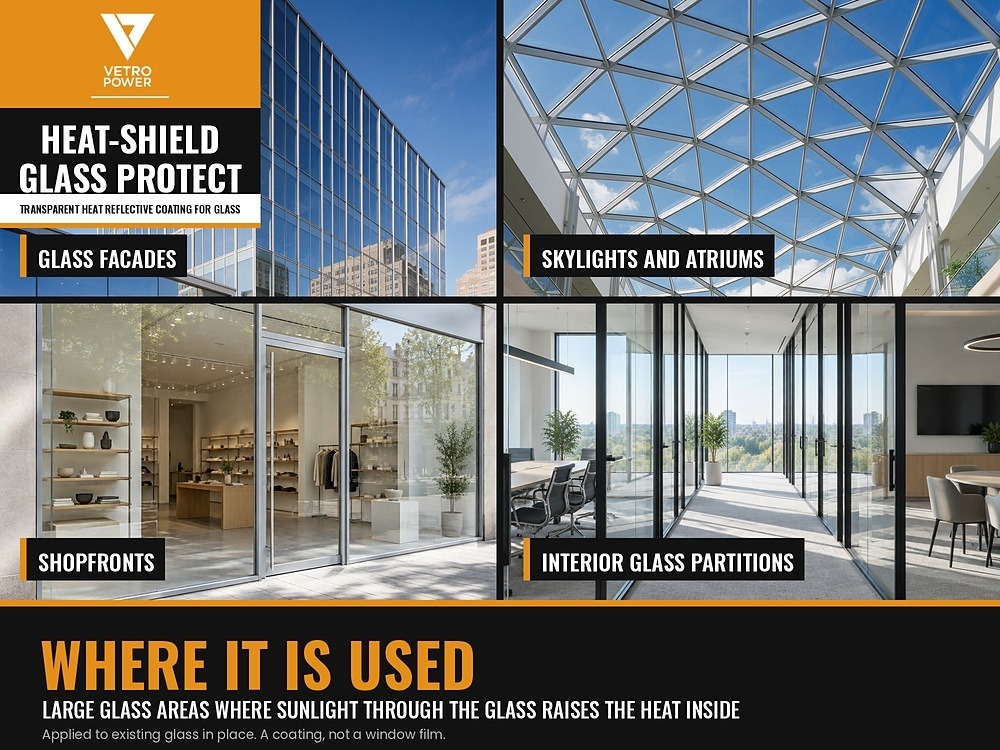
Where it is used
The coating goes on existing glass in place, so buildings and vehicles are treated without replacing the glass.
Application
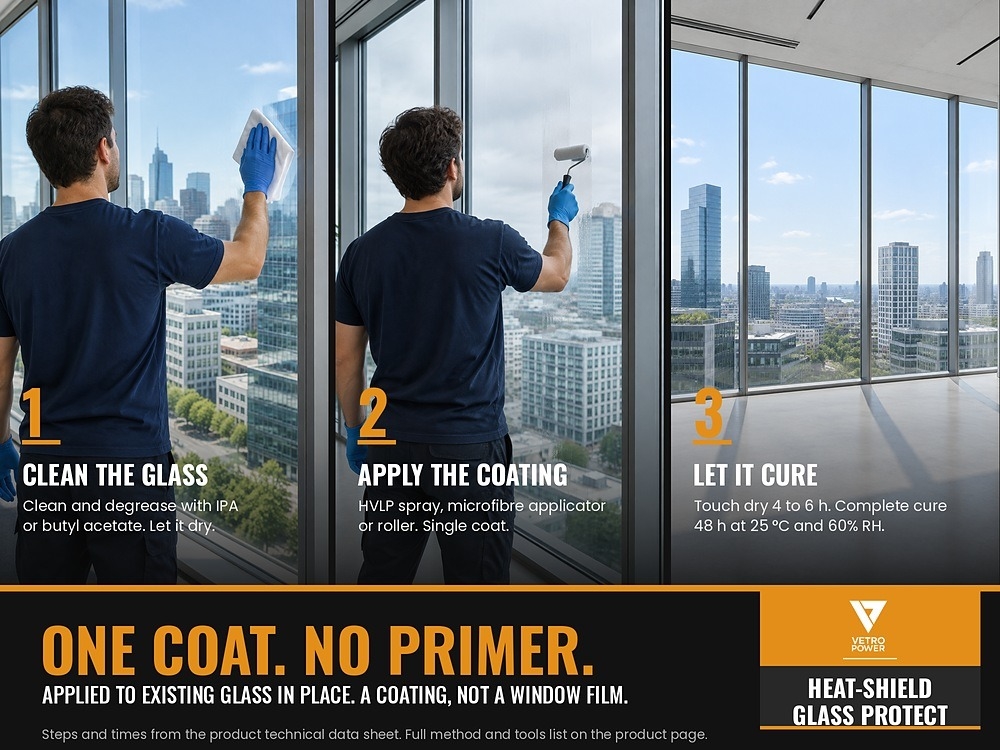
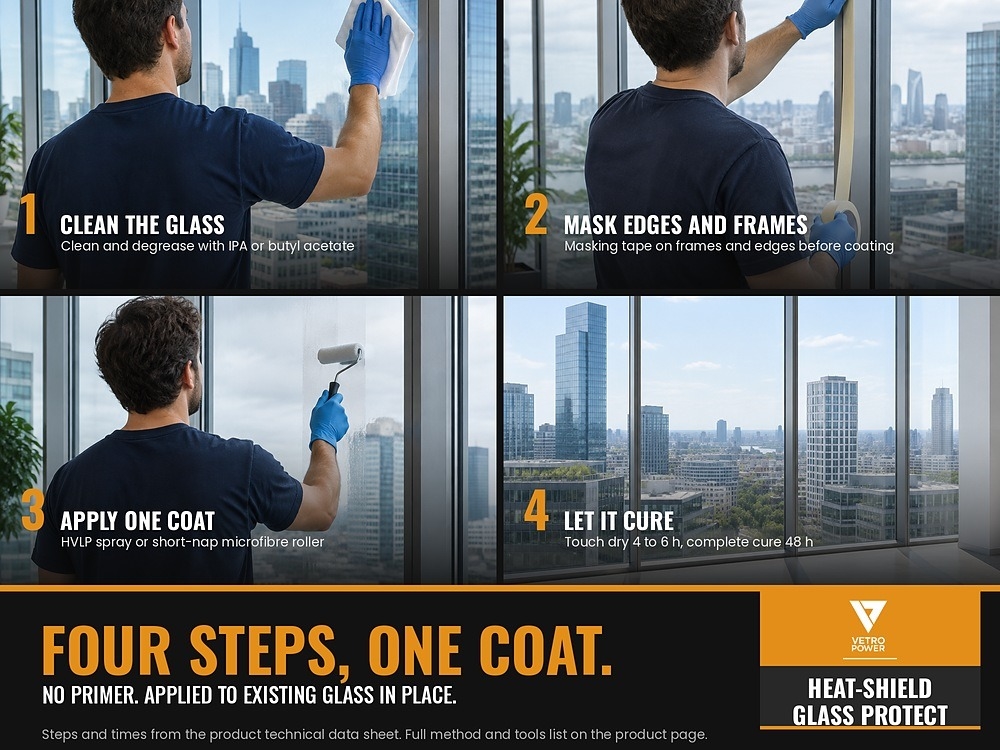
One coat, no primer. The work is in the preparation and in keeping the wet film even.
1. Clean the glass
2. Apply the coating
3. Let it cure
Times at 25 °C and 60% relative humidity. Low temperature and high humidity slow the cure; an IR lamp at 60 to 80 °C brings it to 30 to 60 minutes. Do not wash, wipe or touch the coated glass during the first 48 hours, and allow 7 days before the first cleaning.
Tools for the job
The full application kit is twenty items of ordinary glazing and painting equipment. Disposable items (rollers, applicator foils, mixing cups) are not reused; spray equipment and trays are cleaned immediately after use with butyl acetate or IPA.


Coverage and packaging
| Pack size | Coverage, single coat | Typical use |
|---|---|---|
| 500 ml | About 18.5 m² (about 200 sq ft) | Trial or small project |
| 1 litre | About 37 m² (about 400 sq ft) | Standard pack |
| 5 litre | About 185 m² (about 2,000 sq ft) | Commercial projects |
| 20 litre | About 740 m² (about 8,000 sq ft) | Large facades, bulk |
Coverage is theoretical at the recommended single-coat dry film thickness. Actual coverage varies with the substrate, the application method and the operator; allow 10 to 15% extra for spray or roller loss.
Technical data
Values for the liquid coating and the cured film, tested at 25 °C unless stated. Third-party test reports are available on request.
| Property | Value | Test method |
|---|---|---|
| Technology / base | Doped nano in acrylic-polysiloxane hybrid | |
| Appearance (liquid) | Dark blue liquid | |
| Appearance (cured film) | Optically clear with a blue hue | |
| Base | Solvent-based | |
| Flash point (liquid) | 54 °C, flammable liquid (GHS Category 3) | ASTM D93 |
| VOC content | Up to 350 g/L | ASTM D3960 |
| Odour | Mild solvent odour | |
| Solids content (by weight) | 8 to 28% | ASTM D2369 |
| Viscosity at 25 °C | 6 to 30 mPa·s | ASTM D2196 |
| Wet film thickness | 20 to 60 microns | ASTM D4414 |
| Dry film thickness | 5 to 10 microns (single coat) | ASTM D7091 |
| Refractive index | 1.45 to 1.55 | ASTM D542 |
| Haze after curing | Below 1.5% | ASTM D1003 |
| Pencil hardness | 3H to 5H | ASTM D3363 |
| Adhesion (cross-cut) | 5B, no removal | ASTM D3359 |
| Abrasion resistance (Taber CS-10, 500 g) | Below 5% haze increase after 100 cycles | ASTM D1044 |
| Service temperature range | -20 °C to +120 °C | ASTM D2485 |
| Heat resistance | 120 °C for 4 hours, no change | ASTM D2485 |
| Accelerated weathering (QUV-B) | Pass, over 2000 hours, no yellowing, no delamination | ASTM G154 |
| Salt spray resistance | Over 500 hours, no blistering | ASTM B117 |
| Chemical resistance (mild acid and alkali) | Resistant | ASTM D1308 |
| Flammability of cured film | Non-flammable | |
| Full cure | 7 days |
Care of coated glass
Storage, handling and safety
The liquid is solvent-based and flammable (flash point 54 °C): keep it away from open flames, sparks, hot surfaces and other ignition sources and use it only in a well-ventilated area. The cured film is non-flammable. Store in the original, tightly sealed container in a cool, dry, ventilated place at 5 °C to 30 °C, away from direct sunlight and heat sources. Do not freeze; keep upright. Once opened, reseal tightly and use within 30 days. Shelf life is 12 months from the date of manufacture in the unopened container.
During application wear safety goggles, nitrile gloves and a respirator with an organic vapour cartridge (P2/A2), and cross-ventilate the work area.
Limitations and warranty
- Not recommended for automotive front windshields; local traffic regulations on visible light transmittance may apply.
- Not a structural or safety glass coating; it provides no impact or shatter resistance.
- Performance reduces if applied below the recommended wet film thickness or if the film is uneven.
- Appearance may be affected if applied over scratched, etched or damaged glass.
- Not designed for continuous immersion or wet-area use, for example pool-side glass below the waterline.
- For tinted, low-E or laminated glass, confirm compatibility with a small patch trial before full application.
- The coating is recommended for application on the inner side of the glass. Expected service life is 15 years and more on inner-side application, and 7 to 10 years on outdoor-exposed surfaces, depending on climate and maintenance.
- A 10-year limited warranty against significant performance degradation applies to inner-side application when the coating is applied as per these guidelines and maintained as recommended. Exterior application carries a warranty of up to 5 years. The warranty does not cover mechanical impact, chemical abuse or improper application.
Frequently asked questions
Open or Close Can heat reflective coating be applied to existing glass?
Yes. Vetro Power Heat-Shield Glass Protect is applied directly to glass that is already installed, in a single coat, with no primer. It is used on glass facades, curtain walls, atriums, skylights, windows, sliding doors, balcony glass, storefronts, hotel and restaurant glazing, vehicle windows other than the windshield, greenhouse glass and polycarbonate sheets, display cases and museum glazing, factory windows and boat cabin glass. For tinted, low-E or laminated glass a small patch trial is done first.
Open or Close What is the difference between window film and a heat reflective glass coating?
Window film is a self-adhesive sheet cut to the size of each pane and squeegeed onto the glass, so every pane has edges and large panes may need seams. Vetro Power Heat-Shield Glass Protect is a liquid. It is applied by HVLP spray, microfibre applicator or short-nap microfibre roller and cures into a continuous film 5 to 10 microns thick that is bonded to the glass by silane coupling (cross-cut adhesion 5B, ASTM D3359). There is no adhesive layer, no edges and no joins. Any existing window film has to be removed completely before the coating is applied.
Open or Close Does heat reflective glass coating darken the glass or reduce brightness?
No. The cured film is optically clear, with about 75% visible light transmittance (ASTM E1084 / ISO 9050) and haze below 1.5% (ASTM D1003). What it blocks is ultraviolet (up to 99%) and near-infrared heat (up to 90%). It is not used on automotive front windshields, where local traffic regulations on visible light transmittance may apply.
Open or Close How much glass does one litre of heat reflective coating cover?
About 37 m² (about 400 sq ft) in a single coat at the recommended dry film thickness. A 500 ml pack covers about 18.5 m², 5 litres about 185 m² and 20 litres about 740 m². Coverage is theoretical; allow 10 to 15% extra for spray or roller loss.
Open or Close How long does heat reflective glass coating take to cure?
At 25 °C and 60% relative humidity the film is touch dry in 4 to 6 hours, hard dry in 24 hours, functionally cured in 48 hours and at full hardness in 7 to 30 days. An IR lamp at 60 to 80 °C brings the cure to 30 to 60 minutes. Low temperature and high humidity slow it. The glass is not washed, wiped or touched for the first 48 hours.
Open or Close How do I clean glass with a heat reflective coating?
Wait 7 days for full cure, then use a soft microfibre cloth with plain water or a pH-neutral cleaner, in light circular motions without pressure. No abrasive sponges, scrubbers or steel wool, and no ammonia, bleach, alcohol-based glass cleaners or solvents. For best results clean every 3 to 6 months, depending on how exposed the glass is.
Open or Close Is there a warranty on the coating?
Open or Close Does heat reflective glass coating block UV?
Yes. The cured film blocks up to 99% of UV-A and UV-B, the part of sunlight that fades furniture, fabrics, flooring and artwork. UV and IR transmittance are measured to ASTM E903 / ISO 9050 on 5 mm clear float glass; test reports are available on request.
Open or Close Can heat reflective coating be applied to tinted, low-E or laminated glass?
Only after a patch trial. The coating is tested on clear float glass. On tinted, low-E or laminated glass, compatibility is confirmed with a small patch trial before the full area is coated. It is not applied over scratched, etched or damaged glass, where the appearance of the film may be affected.
Open or Close Is a coating a replacement for heat reflective window film?
Yes. Heat reflective window film, solar control window film and sun control film are bought to cut heat and UV through existing glass. Vetro Power Heat-Shield Glass Protect does the same job as a liquid coating bonded to the glass surface, with no sheet, adhesive, edges or seams, and it is also applied to polycarbonate sheets and skylights.
Packaging